Saturday, April 09, 2005

Friday, April 08, 2005

Bigger phishes ready to spawn

By Matt Hines, CNET News.com
“There's good news about phishing: The growth of new attacks has slowed. But that's only because attackers are building more sophisticated traps and using advanced technology to perpetrate online fraud, researchers say.

Last week, the Anti-Phishing Working Group, an online fraud watchdog, reported that the number of phishing e-mails it tracked between January and February grew by only 2 percent.

That figure seems to mark a significant lessening of the threat, given that the average growth rate has been 26 percent per month since July 2004. But during the January-February period, phishing attacks also became dramatically more complex, experts said.

Whatever form they take, phishing fraud schemes--including offshoots such as pharming, cross-site scripting and DNS poisoning--are getting smarter.

"Phishers are thieves, and thieves in the online world, as in the real world, are working very hard to separate personal financial information and other data from their victims," Microsoft attorney Aaron Kornblum said.…

"People will continue to think up news ways to apply phishing techniques and deceive consumers," he said. "The sophistication is growing, and it's not that surprising at all."

New crooks, more-effective tricks
The first wave of phishing attacks played on the ignorance of unsuspecting consumers, spamming their in-boxes with e-mails that looked like they linked to Web sites belonging to banks, investment companies and e-commerce businesses such as eBay. In reality, they were fake pages designed to lure people into divulging account login data, or other sensitive personal information that could enable the crooks to commit identity fraud.

Recent attacks have gotten more sophisticated, with advances in phishing schemes that use e-mail and the creation of fraudulent Web pages that appear almost identical to their legitimate counterparts.

And new threats have arisen: Attacks based on instant messaging; ploys that use JavaScript technology to hide threats on legitimate Web pages; and new social-engineering strategies.

One of the most telling examples of improved social-engineering techniques is a recent attack that didn't seek to nab victims' names, addresses or Social Security numbers.

Instead, the scheme targeted customers of Salesforce.com, with the aim of stealing information stored on the company's databases.…

Attacks designed to hit specific groups of people who hold valuable information will likely increase, said Jayne Hitchcock, a cybercrime specialist who advises law enforcement agencies and company executives about online fraud and author of the book "Net Crimes & Misdemeanors: Outmaneuvering the Spammers, Swindlers and Stalkers Who Are Targeting You Online."

"Sending a phishing e-mail out to everyone on the Web has had some effect, but not the kind of impact you imagine that some of these more custom-made attacks might have," Hitchcock said. "When you know that a certain group behaves a certain way, or is accustomed to getting information from a known source over e-mail, there's a greater opportunity to play on people's habits and get them to hand over the goods."

Schemes that use instant-messaging services rather than e-mail to distribute fake links are another new way of phishing, Hitchcock said. She pointed to an attack launched via Yahoo Messenger last month as an example. The messages often appear to be sent to IM users from someone on their contact list.…

"The message is coming to them from someone on their buddy list," Hitchcock said. "That's a different level of threat than an e-mail sent from someone you don't communicate with on that medium, and it presents a much greater risk as well. Our research tells us that teens are fast and loose on the Internet and will share information more readily than most adults, so their information could get out via something like IM phishing and ruin their credit before they even get started in life."

Another twist on the old formula keeps the tried-and-true e-mail messages but hides a spoofed URL in a legitimate Web site address.…

Pushing the tech envelope
Online criminals have also begun adopting more-advanced technology. These more-sophisticated phishing methods range from the relatively simple (such as using unprotected URLs maintained by real businesses to redirect users to phishing sites) to the extreme (such as using JavaScript code to add content on top of legitimate pages, a practice known as cross-site scripting).

In… "pharming," online thieves try to redirect people from legitimate sites to malicious ones using "DNS poisoning." The scammers target the servers that act as the white pages of the Internet--a key part of cyberspace that's known as the domain name system, or DNS--and replace the numeric addresses of legitimate Web sites with the addresses of their malicious sites.

There is evidence that when a new form of phishing is reported, another variation on the theme appears, as criminals try to stay one step ahead of the law. Shortly after cross-site scripting began to garner media coverage, researchers at Internet security company Netcraft saw fraudsters loading their content into the internal frame rendering on Web pages, which would allow attackers to victimize people who had turned off JavaScript applications to protect themselves.

This rapid adjustment is proof that more professional criminals and technologists have turned their attention to phishing, according to Paul Mutton, Internet services developer at Netcraft.… ”


http://news.zdnet.com/2100-1009_22-5656070.html?tag=nl.e539

Thursday, April 07, 2005

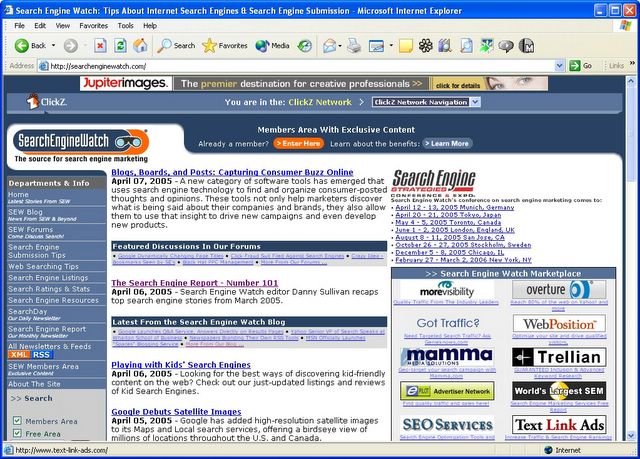
The Search Engine Report - Number 101


By Danny Sullivan, Editor
“In This Issue
SES International!
Top Stories
More From The Search Engine Watch Blog
About The Newsletter
”

What the lsass.exe? Searching for Windows Processes
SearchDay, April 4, 2005

Ever wonder what all of those mysteriously-named Windows 'processes' are doing, and how they got loaded on your computer in the first place? Use the helpful ProcessLibrary.com to find out. This article explores more. (Search Types: Computers)

Looking for Links In All The Wrong Places?
SearchDay, March 29, 2005

In their frenzy to build links to curry favor with the major search engines, web site owners miss a far more important audience that's increasingly turning to topical search sites. (Link Building)

Writing for Search Engines
SearchDay, March 23, 2005

Success in search engines almost always means striking a delicate balance between applying search optimization techniques to web pages and creating high-quality, meaningful content. Effective writing for search engines is the key to achieving this balance. (SEO SEO: Meta Tags SEO: Site Design)…

http://searchenginewatch.com/sereport/article.php/3495881

Saturday, April 02, 2005

If You're Users Can Leave Comments,
You Have the Problem of Comment Spam.

By Ajit Monteiro

“Spam is no longer limited to email. If you run a Website on which you allow users to leave comments, you have undoubtedly faced the problem of comment spam.

The spammers' aim is not to redirect some of your traffic to their site, which is the obvious initial conclusion; it is to increase their (or their clients') ranking in search engines. Most search engines now count in a site's ranking how many other Websites have linked to it. By leaving comments on your site, the spammers' sites can achieve a slightly higher search engine ranking.

The spammers' job is to get around spam-blockers and target the security of individual Websites; though occasionally they do so on a manual basis, by far the most common forms of comment spam are achieved with spam "bots" or scripts. Unfortunately, many site owners don't focus on their Websites as their day job, which can make adapting to spam bots difficult.

Rules of Thumb

When you find that your site is the victim of comment spam, it's easy to react strongly, on a per-case basis, rather than look at the bigger picture. These Rules of Thumb should help you keep things in perspective.

The most important of these rules is: don't take it personally. Spammers don't want to degrade your site. They simply want to get people to their sites and make a larger profit.…”

http://www.sitepoint.com/print/stop-comment-spam

Friday, April 01, 2005

Symantec details flaws in its antivirus software | Tech News on ZDNet

By Matt Hines, CNET News.com

“Symantec has reported glitches in its antivirus software that could allow hackers to launch denial-of-service attacks on computers running the applications. In a notice posted on its Web site this week, Symantec detailed two similar vulnerabilities found in its Norton AntiVirus software, which is sold on its own or bundled in Norton Internet Security and Norton System Works. The flaws, which could lead to computers crashing or slowing severely if attacked, are limited to versions of the software released for 2004 and 2005.

The Information-Technology Promotion Agency of Japan, a government-affiliated tech watchdog group, identified the first instance of the problem in the AutoProtect feature of the Norton AntiVirus consumer product, Symantec said. AutoProtect is used to scan files for viruses, Trojan attacks and worms.”

The Information-Technology Promotion Agency of Japan, a government-affiliated tech watchdog group, identified the first instance of the problem in the AutoProtect feature of Norton AntiVirus. AutoProtect scans files for viruses, Trojans and worms.

Essentially Symantec's software crashes when it is asked to inspect a file specifically designed to exploit the flaw. The file could be submitted remotely from outside a system, or, internally by someone with physical access to a computer.

The second flaw, discovered by the Japan Computer Emergency Response team, can be used to launch denial-of-service attacks by scanning specific file modifications via the SmartScan feature of Norton AntiVirus. Malicious use of that vulnerability would specifically require someone with authorized access to a computer to exploit the issue. SmartScan is designed to scour for viruses hidden in file extensions, as well as in executable and document files.

No attacks related to either problem have been reported so far, according to Symantec.…

http://news.zdnet.com/2100-1009_22-5646871.html?tag=nl.e539

Thursday, March 31, 2005

Boys Wreck Ignition Part 2, Beyond Recognition

I don't understand the need to send messages to the other side of the planet to arrange to fix problems that can only be worked on by someone within the one to five thousand feet between your system an what they call a “central office.”

Over the last few years nearly 30,000 jobs at SBC have been lost. Virtually all of the growth jobs in Internet data services, installation of Wi-Fi hotspots, voice over the Internet (VOIP), DSL broadband and other areas, SBC work, amounting to thousands of jobs, is being outsourced, including going offshore to countries such as India and the Philippines.

"SBC continues to refuse to give this work to our members, the frontline workers who have built SBC into the nation's most profitable telecom company," said CWA President Morton Bahr. SBC's profits in 2003 were more than $8 billion.

http://www.cwa-union.org/news/PressReleaseDisplay.asp?ID=427

Google the terms SBC offshoring DSL and “voice recognition,” and my experience is almost mild compared to say Amanda Brenner's , but , strangely parallels her's, right down to the promise to call back that disappeared from the world as we know it.…

…Or nopaper.net :: start/2004-07-31/1 ...SBC's automated apologies. Our DSL is out right now (11am, ... SBC has implemented a voice recognition menu system, so I was asked to speak my…

It's truly amazing how complicated getting service can be.

It's going to get harder with the FCC helping the Big Guys crush their competition.

The FCC voted 3-2 to suspend public utility commission regulations in Florida, Georgia, Kentucky and Louisiana that had forced BellSouth to sell DSL service to other telephone operators, separate from its local phone service. In the past, the two services had been inextricably linked.…

“"This FCC order continues progress on clearing out regulatory underbrush that handicaps rolling out broadband," Jonathan Banks, BellSouth vice president of federal executive and regulatory affairs, said in a statement. "By affirming a single national policy in this area, this FCC action will increase the speed and efficiency of bringing to consumers new and innovative broadband service offerings over wireline networks. This order is an important step in achieving the president's goal of increased broadband deployment."

A BellSouth spokesman couldn't immediately be reached Friday to discuss the fate of 8,000 or so BellSouth DSL customers in the four states. Aside from users of naked DSL services, an FCC decision would also affect "cord-cutters," a group of about 20 million U.S. residents who don't have local phone lines and go solo instead with their cell phones. As a result of the FCC ruling, cord-cutters may have to buy a local phone line to get DSL.

Providers of voice over Internet Protocol software--which lets an Internet connection serve as a telephone line--will also feel some pain, for the same reason as cord-cutters. VoIP calls are meant to replace phone lines sold by the Bells; and while they're possible with a dial-up connection, most VoIP operators require that users have a broadband connection to make full use of their offerings. As a result of the FCC ruling, some VoIPers must get DSL and a local phone line from a Bell, should a cable operator's more expensive broadband be unavailable in their area.…”

Meanwhile, my state representative's DSL line is down again, and I'm getting better at this Boy's Wreck Ignition thing.

http://techrepublic.com.com/2100-10587_11-5637790.html?tag=nl.e048

Saturday, March 26, 2005

Microsoft Baseline Security Analyzer
(MBSA) version 1.2.1 is available

“This article contains information about the Microsoft Baseline Security Analyzer tool (MBSA). This tool centrally scans Windows-based computers for common security misconfigurations and generates individual security reports for each computer that it scans. MBSA runs on computers that run Windows Server 2003, Windows 2000, and Windows XP. MBSA can scan for security vulnerabilities on computers that run Windows NT 4.0, Windows 2000, Windows XP, and Windows Server 2003. MBSA scans for common security misconfigurations in Windows, Internet Information Services (IIS), SQL Server, Internet Explorer, and Microsoft Office. MBSA also scans for missing security updates in Windows, IIS, SQL Server, Internet Explorer, Windows Media Player, Exchange Server, Microsoft Data Access Components (MDAC), Microsoft XML (MSXML), Microsoft virtual machine (VM), Content Management Server, Commerce Server, BizTalk Server, Host Integration Server, and Office (local scans only). A graphical user interface (GUI) and command-line interface are available in version 1.2.1.


MBSA version 1.1 replaced the stand-alone HFNetChk tool and fully exposes all HFNetChk switches in the MBSA command-line interface (Mbsacli.exe). For additional information about MBSA, visit the following Microsoft Web site:

Download Information

English, French, German, and Japanese versions of MBSA are available from the Microsoft Download Center. Visit the following the MBSA Web page for direct links to download these versions: For additional information about how to download Microsoft Support files, click the following article number to view the article in the Microsoft Knowledge Base:
119591 How to obtain Microsoft support files from online services
Microsoft scanned this file for viruses. Microsoft used the most current virus-detection software that was available on the date that the file was posted. The file is stored on security-enhanced servers that help to prevent any unauthorized changes to the file. ”
‘’…
http://support.microsoft.com/default.aspx?scid=kb;en-us;320454

Back up, Edit, and Restore the Registry in Windows XP

“SUMMARY

Important This article contains information about modifying the registry. Before you modify the registry, make sure to back it up and make sure that you understand how to restore the registry if a problem occurs. For information about how to back up, restore, and edit the registry, click the following article number to view the article in the Microsoft Knowledge Base:
256986 Description of the Microsoft Windows Registry
NoteThe registry in 64-bit versions of Windows XP and Windows Server 2003 is divided into 32-bit and 64-bit subkeys. Many of the 32-bit subkeys have the same names as their 64-bit counterparts, and vice versa. The default 64-bit version of Registry Editor that is included with 64-bit versions of Windows XP and Windows Server 2003 displays the 32-bit subkeys in the following registry subkey, or "hive":
HKEY_LOCAL_MACHINE\SOFTWARE\WOW6432Node
For additional information about how to view the registry on 64-bit versions of Windows, click the following article number to view the article in the Microsoft Knowledge Base:
305097 How to view the system registry by using 64-bit versions of Windows

REFERENCES

314837 How to manage remote access to the registry
310595 Description of HKEY_CURRENT_USER registry subkeys
310593 Description of the RunOnceEx registry key
307545 How to recover from a corrupted registry that prevents Windows XP from starting
286422 How to back up and restore a Windows Server 2003 cluster
104169 Files that are automatically skipped by the backup program (NTBackup.exe) during the backup and restore processes
310426 How to use the Windows XP and Windows Server 2003 Registry Editor features ”

For a Microsoft Windows 2000 version of this article, see 322755.
For a Microsoft Windows NT 4.0 version of this article, see 323170.
For a Microsoft Windows 95, 98, and Millennium Edition version of this article, see 322754.

http://support.microsoft.com/kb/322756

Friday, March 25, 2005

The six dumbest ways to secure a wireless LAN

by ZDNet's George Ou

“ For the last three years, I've been meaning to put to rest once and for all the urban legends and myths on wireless LAN security. Every time I write an article or blog on wireless LAN security, someone has to come along and regurgitate one of these myths. If that weren't bad enough, many "so called" security experts propagated these myths through speaking engagements and publications and many continue to this day. Many wireless LAN equipment makers continue to recommend many of these schemes to this day. One would think that the fact that none of these schemes made it in to the official IEEE 802.11i security standard would give a clue to their effectiveness, but time and time again ...”

http://blogs.zdnet.com/Ou/index.php?p=43

Mozilla fixes risky Firefox flaw

By Robert Lemos, CNET News.com

“The Mozilla Foundation issued a patch for a major security flaw in its Firefox browser on Wednesday and advised people to update their software.

The problem is caused by a buffer overflow in legacy Netscape code still included in the browser for animating GIF images, Chris Hofmann, director of engineering for Mozilla, said. Similar memory problems have affected Mozilla's browsers and Microsoft's Internet Explorer in the past. A malicious attacker could exploit them by creating carefully crafted image files that, when viewed by a victim in a browser, execute a program and compromise the system.

The flaw was discovered by Internet Security Systems, a network protection company, and patched before the public learned of the issue, Hofmann said.

"We are staying ahead and being proactive in fixing the code," he said. "The deciding factor, in this case, was the potential for this: It's a little easier for hackers to turn it into an exploit that could be dangerous."

The Mozilla Foundation released version 1.02 of Firefox on Wednesday to fix the problem and asked that all users to download and apply the patch.

Recently published data has prompted questions about the security of Firefox. Security technology provider Symantec said in this week's Internet Threat Report that during the second half of last year, 21 vulnerabilities affected Mozilla browsers and 13 flaws affected Internet Explorer.

However, only seven of the flaws in Firefox were considered "highly severe," compared with nine in Internet Explorer.”

http://news.zdnet.com/2100-1009_22-5632148.html?tag=nl.e589

Thursday, March 24, 2005

Father of Word and Excel shoots for three-peat with Intentional Software

by ZDNet's David Berlind
“ Father of Word and Excel shoots for three-peat with Intentional Software

-- Like the blockbuster movie producer or director who works behind the scenes but whose celebrity is often confined to Hollywood insiders, Dr. Charles Simonyi is a giant among giants here at PC Forum in Scottsdale, Ariz. If you strike up a conversation with the easily approachable, mild-mannered, Hungarian-born software legend and passers-by such as Jeff Bezos (founder of Amazon.com) or Tim O'Reilly detect that Simonyi is even slightly engaged, they'll stop and tune-in.After leaving Xerox PARC, Simonyi joined Microsoft in 1981 and fathered two of the three biggest franchises in Microsoft's history -- Word and Excel. After a storied 21-year tenure with the Redmond, Wash.-based company, Simonyi is looking for a three-peat. But this time, it's not with Microsoft....
Trackback URL for this post: http://blogs.zdnet.com/BTL/wp-trackback.php/1190 ”

http://blogs.zdnet.com/BTL/index.php?p=1190&tag=nl.e539

Monday, March 21, 2005

“Description of the undiscovered tips about Excel

•Join text in multiple columns
•Set the print area
•Exclude duplicate items in a list
•Multiply text values by 1 to change text to numbers
•Use the Text Import Wizard to change text to numbers
•Sort decimal numbers in an outline
•Use a data form to add records to a list
•Enter the current date or time
•View the arguments in a formula
•Enter the same text or formula in a range of cells
•Link a text box to data in a cell
•Link a picture to a cell range
•Troubleshoot a long formula
•View a graphical map of a defined name
•Fill blank cells in a column with contents from a previous cell
•Switch from a relative reference to an absolute reference
•Use the OFFSET function to modify data in cells that are inserted
•Use the Advanced Filter command
•Use conditional sums to total data
•Use conditional sums to count data
•Use the INDEX function and the MATCH function to look up data
•Drag the fill handle to create a number series
•Automatically fill data
•Use the VLOOKUP function with unsorted data
•Return every third number
•Round to the nearest penny
•Install and use Microsoft Excel Help
•Do not open and save directly from a floppy disk
•Use one keystroke to create a new chart or worksheet
•Set up multiple print areas on the same worksheet”

http://support.microsoft.com/default.aspx?scid=kb;en-us;843504

Sunday, March 20, 2005

They should call it "Boys Wreck Ignition"

By Alfred Ingram

Remember when ‘touch tone terror’ first entered our lives?

In all innocence we called a bank, or a pharmacy, or, most likely, the dtmf (dual tone multi frequency)-ing phone company itself, got a menu of choices too long to remember, started over and became even more confused the second time around.

Remember finally giving up in total frustration, perhaps even paying a charge we just knew was wrong?

Well they've fouled it up beyond all “wreck ignition,” again.

SBC has managed to do the barely possible, crossbreed help desk hell with touch tone hell, add a not ready for public technical capability, and give birth to voice recognition that has a hard time recognizing standard english.

Anyway, that's what I discovered when I had both a dead router and a bad DSL line and had to contact SBCYahoo for service at my State Representative's office.

Of course, now that I, along with the rest of the industrializedworld, am used to punching the keypad for menu selections, I wasn't able to do so.

The first day a total waste because SBC couldn't identify the state representative as a DSL customer. I'd say the number of the phone I was calling from (whatever happened to caller id?) and the machine consistently read back a number I'd never given it, finally driving me to hang up to try again the next day.

On day two I decided to call on from the half of the line (DSL splits a standard line) that wasn't hooked to the router and wound up talking to someone with an Indian accent who “insisted” that his name was “Matt.” That's when I discovered that I had a bad router, a bad line, and a help desk on another continent. After checking the line “Matt” told me they'd known of the problem for a week, but, apparently, doing anything about it called for someone on this side of the planet.

“Matt” arranged for SBC to call the next day at eleven, (so somone here in the United States could analyse the problem) so of course no one called. When I called to find out why, they claimed to be waiting for my call. “Matt” from India was not available to verify or deny either side of this foul up.…

more coming soon…

Saturday, March 19, 2005

The Failure of Two-Factor Authentication

Schneier on Security

“Two-factor authentication isn't our savior. It won't defend against phishing. It's not going to prevent identity theft. It's not going to secure online accounts from fraudulent transactions. It solves the security problems we had ten years ago, not the security problems we have today.

The problem with passwords is that they're too easy to lose control of. People give them to other people. People write them down, and other people read them. People send them in e-mail, and that e-mail is intercepted. People use them to log into remote servers, and their communications are eavesdropped on. They're also easy to guess. And once any of that happens, the password no longer works as an authentication token because you can't be sure who is typing that password in.

Two-factor authentication mitigates this problem. If your password includes a number that changes every minute, or a unique reply to a random challenge, then it's harder for someone else to intercept. You can't write down the ever-changing part. An intercepted password won't be good the next time it's needed. And a two-factor password is harder to guess. Sure, someone can always give his password and token to his secretary, but no solution is foolproof.

These tokens have been around for at least two decades, but it's only recently that they have gotten mass-market attention. AOL is rolling them out. Some banks are issuing them to customers, and even more are talking about doing it. It seems that corporations are finally waking up to the fact that passwords don't provide adequate security, and are hoping that two-factor authentication will fix their problems.

Unfortunately, the nature of attacks has changed over those two decades. Back then, the threats were all passive: eavesdropping and offline password guessing. Today, the threats are more active: phishing and Trojan horses.…”

http://www.schneier.com/blog/archives/
2005/03/the_failure_of.html

Friday, March 18, 2005

Adobe Pushes DNG Image Format

By Kathy White

“Many photographers work in RAW-format files from their
digital cameras and are frustrated by the many versions out
there—varying not just from manufacturer to manufacturer but also from
camera to camera. But Adobe is trying to solve that problem with its
Digital Negative Specification.

Adobe Systems Inc. in September 2004 introduced DNG, a public format
for RAW digital camera files, along with a free software tool, Adobe
DNG Converter, which translates many of the RAW photo formats (images
before any in-camera processing) used today into the new DNG file
format.

Adobe is also letting any manufacturer that wants to use the format in
its cameras, printers and software applications do that for free
without any limitations in the hopes of encouraging them to accept it
as the standard.

Shooting RAW images means photographers can avoid dealing with the
compression and loss of image quality involved with shooting JPEGs.
But with that change comes the problem that Adobe has addressed: Each
manufacturer uses a proprietary format that is specific to its cameras
and might not be compatible with Adobe's Photoshop or other editing
software.

The Digital Negative Specification, Adobe hopes, will become the
single format, allowing users to store information from a diverse
range of cameras.…”

http://www.publish.com/article2/0,1759,1776862,00.asp

Alternative Browsers and Java Lead Spyware to IE

By Michael Myser
“Windows and Microsoft products are going to be the first targets because they're so ubiquitous. Other applications will become targets as they become more popular.”
According Christopher Boyd, the Vitalsecurity.org researcher, versions of alternative browsers including Firefox, Mozilla, Netscape and Avant all allow the execution of code within IE.…

“A malicious batch of adware and spyware has appeared that can use Firefox and other alternative browsers to infect Microsoft's IE.

According to a researcher at Vitalsecurity.org in the United Kingdom, if a user visits a site hosting the malicious code and agrees to install the applications despite security warnings, Internet Explorer will automatically run and deluge the computer with pop-up ads and offers, regardless of IE security settings.

While the security and infection threat is relatively low—in addition to the security warnings, the code only affects users of Sun's JRE (Java Runtime Environment), and so far is only found at a Neil Diamond lyrics site—it illustrates the continued expansion of malicious code targeting alternative browsers, as well as a unique cross-browser capability.…

"Firefox will retain an edge in security for some time, but the notion that you'll be impervious to threats due to using Firefox is an illusion," said Jim Slaby, a senior analyst with the Yankee Group.

"The criminal element has decided that it's profitable enough to write malware that targets it."

This code, however, doesn't work only through Firefox to get at IE.…”

http://www.eweek.com/article2/0,1759,1776347,00.asp

Wednesday, March 16, 2005

How to Record a Podcast

by Glenn Fleishman
“Podcasting involves two distinct tasks. First you have to record the audio and prepare it for listening. Then you need to syndicate it via RSS so others can subscribe to your programs. In this tutorial, Glenn Fleishman shows you some nifty tricks for recording your audio, especially if you want to capture phone interviews for syndication.”

http://www.macdevcenter.com/pub/a/mac/2005/01/25/podcast.html

Frequently asked questions about the automated
portion of the Microsoft Protect Your PC Web site

“This article contains a list of answers to frequently asked questions (FAQ) about the automated portion of the Microsoft Protect Your PC Web site.”

•Q1: What is the automated portion of the Protect Web site?
•Q2: How do I access the automated portion of the Protect Your PC Web site?
•Q3: What versions of Windows does the automated portion of the Protect Your PC Web site Support?
•Q4: Who should use the automated portion of the Protect Your PC Web site?
•Q5: What credentials must my account have to use the automated portion of the Protect Your PC Web site?
•Q6: How does the automated portion of the Protect Your PC Web site work?
•Q7: What does each step of the automated portion of the Protect Your PC Web site Do?
•Q8: After I turn on ICF/WF, some of my games and other programs do not work correctly. How can I work around this?
•Q9: Where can I find more information about the automated portion of the Protect Your PC Web site?


http://support.microsoft.com/default.aspx?scid=kb;en-us;828931

Saturday, March 12, 2005

Has Your Address Been Spoofed?

Deb Shinder, Editor WinXPnews
“Are you getting e-mail messages from administrators of other mail domains, notifying you that the messages you sent were undeliverable? When you open these, do you find that you never sent a message to the supposed recipient? Sometimes these messages indicate that you have a virus sending e-mail from your account without your knowledge. Other times, though, the mail didn't come from your account at all - instead, somebody spoofed your e-mail address and used it as their return address.

Either way, it's more than just an anomaly or an annoyance. If your address is used to send spam, it may be reported to various "spam cop" organizations, resulting in your address - or even your entire domain - being added to various public blacklists of known spammers. And that means the legitimate e-mail you send won't get through to a lot of recipients. Not a good situation. You can read more about how e-mail spoofing is done in my article at http://www.winxpnews.com/rd/rd.cfm?id=050308ED-Spoofing.

What can you do about it? The federal CAN SPAM Act makes it illegal to send unsolicited commercial e-mail with false or misleading headers (return addresses). Unfortunately, you can't prosecute someone for this or any other crime unless you know who the perpetrator is.

Okay, what if your name ends up on a black list? Is there anything you can do about that? The answer is: sometimes. There are many different black lists, so the first challenge is to find out which list(s) are identifying you as a spammer. There is a list of some black lists at http://www.winxpnews.com/rd/rd.cfm?id=050308ED-Black_Lists. In some cases, you can write to those who maintain the lists and explain what happened and ask to have your address removed. Here is an article that contains info on how to get off of specific blacklists: http://www.winxpnews.com/rd/rd.cfm?id=050308S1-Off_Blacklists. Have you been blacklisted? If others are telling you that your e-mails don't reach them, it might be because you're on a blacklist. Many ISPs use blacklists to block spam at the server level.”

http://www.winxpnews.com/?id=166